
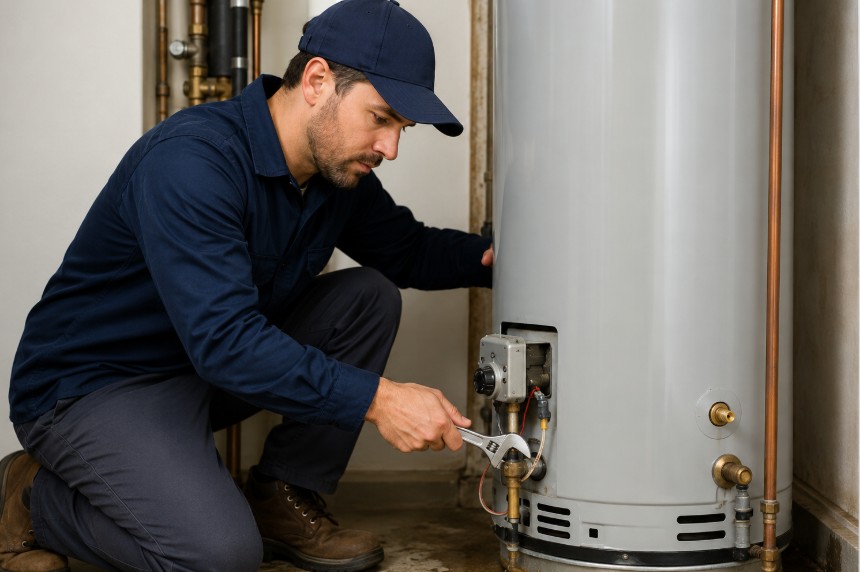
Emergency Water Heater Repair in Memphis, TN
No hot water, or a tank that's leaking? A licensed technician can be dispatched today — nights, weekends, and holidays included — with a real diagnosis before any repair starts.
Get a quote24 hour water heater repair in Memphis tn
A water heater doesn't usually fail with a warning — it's fine one day and cold, leaking, or making a noise it shouldn't the next. Memphis Emergency HVAC Pros provides emergency water heater repair across Memphis and Shelby County, any time of day, for both tank and tankless systems. Whether it's no hot water at all, a leak at the base of the tank, or a relief valve that won't stop discharging, we diagnose the actual cause before recommending a fix.
Why Memphis Water Heaters Face a Different Set of Problems
Memphis draws its drinking water entirely from the Memphis Sand Aquifer — layers of ancient sand and clay acting as a natural filter hundreds of feet underground — and the result is water that's generally soft to moderately soft compared to most of the country. That's a genuine advantage for a water heater. Hard water is one of the leading causes of early tank failure elsewhere, since calcium and magnesium minerals settle out as scale on heating elements and tank walls, insulating them from the water and forcing the unit to work harder than it should. Memphis homeowners tend to get more usable life out of a tank's original elements and anode rod largely because of what's coming out of the aquifer in the first place.
That said, the aquifer's quality doesn't guarantee a spotless supply by the time water reaches every tap. Parts of Memphis's distribution system still run through cast iron mains installed decades ago, and aging infrastructure like this can introduce its own sediment and trace iron into the water on the way to an older home — especially one with aging internal plumbing. So even in a comparatively soft-water city, a water heater in an older Midtown or Downtown home can accumulate more tank sediment over the years than the raw aquifer water alone would suggest. Sediment is still sediment, whether hardness minerals or fine rust particulate deposited it.
Housing age plays a role beyond water quality, too. Many older Memphis homes still run smaller-capacity tanks — often 30 to 40 gallons — installed for a household size or usage pattern from decades ago, tucked into tight closets or crawlspaces that make even simple repairs more cramped. Newer construction across Cordova, Collierville, and other suburbs more commonly has garage- or utility-room-mounted tanks with easier access, and increasingly tankless units, which changes what an "emergency" repair even looks like.
Signs You Need Emergency Water Heater Repair
- No hot water at all — could be a failed heating element (electric units), a pilot or ignition failure (gas units), or on a tankless system, an ignition or flow sensor fault.
- Water heater leaking at the base — often means the tank itself has failed internally, which usually isn't something to patch.
- Rusty or discolored hot water — can point to a failing anode rod or internal tank corrosion, especially in an aging unit.
- Popping, rumbling, or banging noises from the tank — usually sediment at the bottom of the tank being disturbed as the water heats.
- Water that's scalding or won't get hot enough — could be a thermostat, heating element, or burner issue depending on the system.
- The relief valve is leaking or discharging heavily — a safety component doing exactly what it's supposed to, but one that needs prompt attention, not a cap or a bucket underneath it.
- A gas smell near a gas water heater — treat this like any gas appliance issue: leave the area, avoid operating switches, and call the gas utility or 911 before calling for repair.
- A tankless unit displaying an error code or shutting off mid-use — the system is already flagging a specific fault, which usually speeds up diagnosis.
Common Water Heater Problems We Fix in Memphis
-
Failed heating element (electric tank units) — one of the most common causes of no hot water or inconsistent temperature.
-
Pilot light or ignition failure (gas units) — prevents the burner from firing at all.
-
Failing thermostat — causes water that's too hot, not hot enough, or inconsistent between uses.
-
Sediment buildup — settles at the bottom of tank units over time, reducing efficiency and causing noise.
-
Corroded or depleted anode rod — the anode rod is designed to corrode instead of the tank; once it's used up, the tank itself starts corroding.
-
Relief valve issues — either failing to release pressure when needed, or discharging because of an underlying problem elsewhere in the system.
-
Tankless-specific issues — mineral scale on the heat exchanger, flow sensor faults, or venting problems on gas tankless units.
-
Leaks — at fittings, valves, or the tank itself.
What to Expect: Our Emergency Water Heater Repair Process
-
Initial Inspection — Assessment of the unit — tank or tankless, gas or electric — and its connections.
-
Thorough Diagnostics — Testing the actual component at fault, whether that's an element, thermostat, anode rod, or relief valve, or on tankless units, the flow sensor and heat exchanger, rather than defaulting to a full replacement recommendation.
-
Upfront Quote — A clear price before any work begins.
-
Repair — Most issues resolved in the same visit.
-
Final System Test — Confirming consistent hot water output and proper pressure relief before we leave.
What Affects the Cost of Emergency Water Heater Repair
-
What's actually broken — A heating element or thermostat fix costs far less than a full tank replacement.
-
Tank vs. tankless — Tankless units involve different diagnostic time and parts than a standard storage tank.
-
Age and sediment level — An older, heavily sedimented tank may need more than a quick fix to keep running reliably.
-
Timing — After-hours or emergency dispatch is quoted upfront, same as any other call.
We provide a free, upfront estimate before any work begins, so you get a real number for your specific system.
Water Heater Safety: What the Relief Valve Protects Against
Every tank water heater has a temperature and pressure relief valve, and it exists for a genuinely serious reason. A tank heats a large, enclosed volume of water, and if the thermostat fails and keeps heating past a safe point, or pressure inside the tank builds beyond what it's designed to hold, the relief valve is what releases that excess before it becomes dangerous. Without it functioning correctly, a malfunctioning tank can, in rare but real cases, fail catastrophically.
A relief valve that occasionally drips a small amount of water is often just doing its job during a normal heating cycle. One that's leaking steadily, won't stop discharging, or has been capped off or disconnected — sometimes done, incorrectly, to stop an annoying drip — is a different situation entirely. That's a safety component that needs to actually work, not one to disable. If your water heater's relief valve is discharging heavily, shut off the unit's power or gas supply and call for service rather than waiting it out.
Why Waiting on Water Heater Repair Costs You More
A water heater problem tends to get worse quietly. Sediment sitting at the bottom of a tank keeps accumulating and insulating the heating element from the water it's supposed to heat, so the unit works harder and less efficiently the longer it's ignored — often well before anyone notices reduced hot water. A slow leak at a fitting or valve can go unnoticed until it's caused real water damage to a closet, garage, or the flooring nearby. And a tank nearing the end of its service life that starts showing early warning signs — discolored water, popping noises, a minor leak — is far more likely to fail completely, often at an inconvenient time, if those signs get ignored instead of addressed. Catching a water heater issue early is almost always the cheaper option, and often the one that avoids real water damage rather than just an inconvenience.
Why Memphis Homeowners Trust Us with Water Heater Repair
-
24/7 emergency dispatch — real people answer, any hour, any day
-
Free, upfront estimates before repair work begins
-
Licensed and insured technicians experienced with both tank and tankless systems
-
Transparent pricing — no guessing, no inflated add-ons
-
Satisfaction guaranteed on every repair
Service Area
We provide emergency water heater repair throughout Memphis and Shelby County, including Bartlett, Cordova, Germantown, Collierville, Millington, Arlington, Lakeland, Whitehaven, Raleigh, Frayser, Hickory Hill, and Eads.
FAQs
Why does my water heater make popping or rumbling noises?
Almost always sediment that's settled at the bottom of the tank, being disturbed and heated. It's common in tank units that haven't been flushed in a while, and while it's not usually an emergency on its own, it's worth addressing before it affects efficiency further.
Is a small drip from my water heater's relief valve normal?
Occasionally, during a normal heating cycle, a small amount of discharge can be normal. Steady leaking, or discharge that won't stop, means the valve is either doing its job because something else is wrong, or it's failing itself — either way, it's worth a technician's attention rather than capping it off.
How long should a water heater actually last?
Tank water heaters typically run 8–12 years, and Memphis's comparatively soft water tends to work in a tank's favor over that span. Tankless units often last considerably longer with proper maintenance, since there's no large tank to corrode.
Why is my hot water rust-colored?
Usually a failing anode rod or internal tank corrosion, especially in an older unit. Worth having checked, since it can be an early sign the tank itself is nearing the end of its service life.
Do I still need to flush my water heater in Memphis if the water here is soft?
Less often than in a genuinely hard-water city, but it's not a non-issue — sediment can still enter the system from aging distribution infrastructure, especially in older parts of Memphis, so periodic flushing still extends the life of the tank.